
According to The Hollywood Reporter, the turning point when the old model for marketing strategy became obsolete is precise:
“2014… marked the peak of a monoculture that no longer exists.”
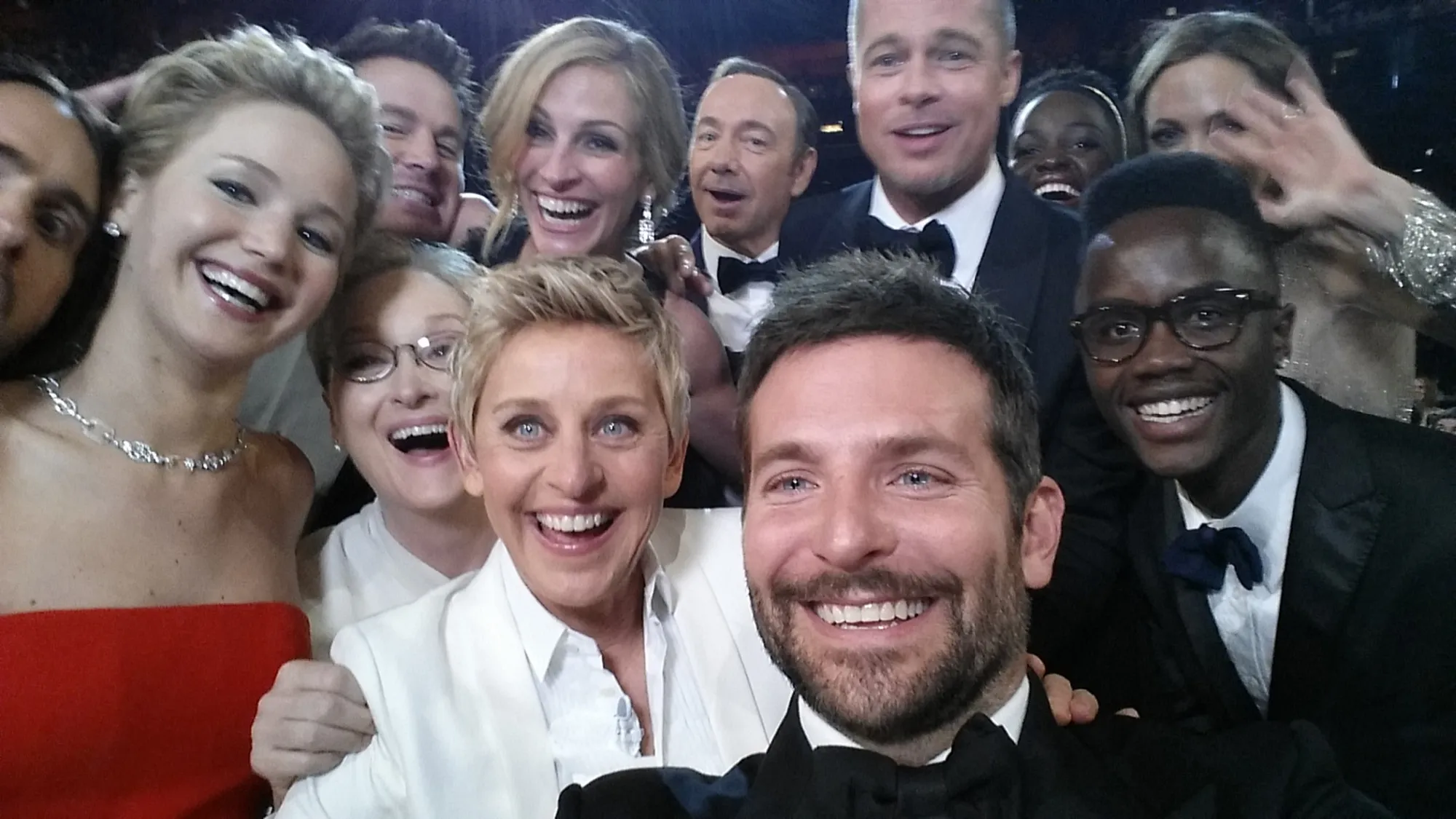
On March 2, 2014, Ellen DeGeneres posed for a selfie taken by Bradley Cooper with Jared Leto, Jennifer Lawrence, Channing Tatum, Meryl Streep, Julia Roberts, Kevin Spacey, Brad Pitt, Lupita Nyong’o, Angelina Jolie, and Peter Nyong’o Jr. during the 86th Annual Academy Awards.
The Hollywood Reporter cites that single, iconic image, which reached millions simultaneously, dominated global conversation, and even crashed platforms under the weight of shared attention, as the last time the old system worked perfectly.
It was a single piece of content connecting with a global audience in a unified cultural moment.
And then it stopped.
What Monoculture Enabled (And Why It Worked)
Monoculture wasn’t just about entertainment, it was a distribution advantage for every marketing strategy.
It meant:
– Limited channels → concentrated attention
– Shared media consumption → predictable reach
– Cultural alignment → faster impact
In practical terms, marketing strategy was straightforward:
Buy scale → create awareness → drive conversion.
The system rewarded:
– Big campaigns
– Mass media buys
– Celebrity endorsements
Because everyone was watching the same thing.
The Collapse: What Broke After 2014
The Hollywood Reporter’s framing is critical—not that monoculture slowly faded, but that it peaked and then fragmented.
Three structural shifts drove that collapse:
1. From Shared Screens to Personalized Feeds
Algorithmic platforms replaced broadcast logic.
Instead of everyone seeing the same content:
– Each user sees a different version of reality
– Discovery is individualized
– Attention is fragmented by design
2. From Scarcity to Infinite Supply
Streaming and digital platforms removed distribution limits.
Where once there were:
– A handful of TV channels
– A finite number of cultural touchpoints
Now there are:
– Infinite content streams
– Continuous competition for attention
Even major hits no longer dominate for long.
3. From Mass Identity to Micro-Cultures
Audiences didn’t just fragment—they reorganized.
Today:
– Culture exists in clusters
– Communities define relevance
– Influence is contextual
There is no “general audience” anymore—only overlapping segments.
The Real Marketing Impact: The Death of Scale as a Shortcut
The key implication is not fragmentation, it’s the loss of efficiency.
Pre-2014:
– Reach = influence
– Frequency = recall
– Scale = results
Post-2014:
– Reach without relevance is wasted
– Visibility without context doesn’t convert
– Scale without segmentation dilutes impact
This is why legacy campaigns increasingly underperform. They’re built for a system that no longer exists.
Where Marketing Strategy Has Gone Now
The death of monoculture didn’t kill marketing, but it did redistribute power.
1. From Audience → Ecosystems
There is no single audience.
Brands must operate across:
– Creator networks
– Platform-native communities
– Interest-driven clusters
Relevance now travels through networks, not broadcasts.
2. From Campaigns → Always-On Systems
Campaign thinking assumes attention can be “captured.”
But attention today is:
– Continuous
– Competitive
– Platform-dependent
Winning brands build:
– Persistent visibility
– Layered content strategies
– Cross-channel reinforcement
This is why PR, content, SEO, and creators must function as one system for marketing strategy—not separate tactics.
3. From Influencers → Distributed Trust
Influence is no longer centralized.
Instead:
– Nano and micro creators drive engagement
– Trust is built through relatability
– Authority is niche-specific
A single celebrity no longer moves markets. A network of credible voices does.
4. From Media Buying → Attention Design
You can’t buy attention—you have to earn it.
That means:
– Designing content for algorithms
– Structuring narratives for feed environments
– Optimizing for discovery, not interruption
The shift is from placement to participation.
5. From Cultural Moments → Cultural Presence
The Oscars selfie worked because it captured a monoculture moment.
That model is gone.
Today:
– Cultural relevance is continuous
– Impact is cumulative
– Success comes from sustained presence, not spikes
Brands must show up repeatedly, not just loudly.
What This Means for Foundeast Clients
Our takeaway is operational, not theoretical:
Marketing success today requires:
– Integrated PR + content + creator ecosystems
– Multi-market, platform-native execution
– Continuous optimization based on behavior
This aligns directly with how audiences now discover and validate brands:
– Through creators
– Through communities
– Through repeated exposure across channels
In other words: marketing is no longer a campaign—it’s infrastructure.
Final Thought
The Hollywood Reporter didn’t just identify a cultural shift, it identified a strategic one.
2014 wasn’t just the peak of monoculture. It was the end of marketing built on mass attention.
What replaced it is more complex, but also more precise:
– Fragmented audiences
– Networked influence
– Continuous discovery
The opportunity hasn’t disappeared. It’s evolved. But only for brands that understand one thing clearly:
You’re no longer marketing to everyone. You’re building relevance, one audience cluster at a time.