
In today’s fragmented media landscape, brands no longer communicate through a single channel. Messages travel simultaneously across PR, social media, advertising, executive communications, influencer campaigns, and owned content platforms. Without a clear strategic foundation, messaging quickly becomes inconsistent — weakening brand authority and confusing audiences.
This is why key message houses have become one of the most indispensable tools in modern communications strategy. Once considered primarily a public relations framework, message houses are now essential across integrated marketing ecosystems, ensuring clarity, consistency, and scalability across every touchpoint.
Below are the top reasons why organizations — from multinational corporations to fast-growing regional brands — rely on message houses as a core communications asset.
1. Key Message Houses Create Strategic Message Consistency Across Channels
Today’s audiences encounter brands through multiple entry points: news coverage, TikTok videos, LinkedIn posts, paid ads, executive interviews, and website content. Each interaction shapes perception.
A message house establishes:-
– A single narrative foundation
– Unified positioning language
– Approved proof points and claims
Without this structure, marketing teams often improvise messaging independently, leading to subtle contradictions. Over time, inconsistency erodes trust and brand clarity.
Well-built key message houses ensure that PR headlines, social captions, and advertising copy all reinforce the same strategic story — even when adapted for different audiences.
2. They Align Internal Stakeholders
One of the biggest communications risks rarely comes from the public — it comes from inside organizations.
Different departments often describe the company differently:
– Sales focuses on features.
– Marketing emphasizes lifestyle benefits.
– Executives speak in vision statements.
– PR highlights credibility and partnerships.
Key message houses act as organizational alignment tools, giving leadership, communications teams, agencies, and partners a shared language framework.
This alignment becomes especially critical during:
– Product launches
– Market expansion
– Mergers and acquisitions
– Crisis communications
When everyone speaks from the same structure, messaging becomes faster, clearer, and more confident.
3. They Strengthen Brand Authority and Media Credibility
Journalists and audiences quickly recognize when messaging lacks coherence. Brands that communicate inconsistently appear reactive rather than strategic.
Key message houses improve media outcomes by providing:
– Clear positioning statements
– Supporting evidence and data points
– Repeatable narrative themes
Consistency across interviews, press releases, and commentary signals expertise — which increases the likelihood of media trust and repeat coverage.
In SEO terms, this also strengthens topical authority, as consistent messaging reinforces keyword themes across earned, owned, and shared media.
4. Key Message Houses Power Integrated PR, Social Media, and Advertising Campaigns
Modern campaigns succeed when paid, earned, shared, and owned media reinforce each other.
Key message houses enable seamless adaptation across formats:
PR and Media Relations
Message houses provide structured media angles, spokesperson talking points, and consistent positioning statements. This ensures press releases, interviews, and commentary reinforce the same strategic narrative regardless of journalist or outlet.
Social Media Content
Message pillars translate directly into content themes and storytelling directions. Social teams can create posts, captions, and short-form videos that remain aligned with brand positioning while still adapting tone and creativity for each platform.
Advertising and Paid Campaigns
Core value propositions drawn from the message house inform campaign copy, headlines, and calls-to-action. This alignment ensures advertising reinforces brand perception rather than operating as disconnected promotional messaging.
Influencer and Creator Marketing
Influencers perform best when given narrative clarity without scripted language. Message houses help agencies develop briefing documents that communicate key themes, proof points, and brand intent while allowing creators authentic expression.
Website and SEO Content
Message pillars guide website structure, landing page messaging, and editorial strategy. Consistent terminology and positioning strengthen keyword authority and improve search engine relevance over time.
Instead of reinventing messaging for each campaign, teams can modularly adapt approved messages — improving efficiency while maintaining strategic coherence.
5. They Improve Speed During High-Stakes Communications
In fast-moving situations — especially crises — speed matters as much as accuracy.
Organizations without predefined messaging frameworks often lose valuable time debating wording internally. A message house provides pre-approved positioning that allows teams to respond quickly while staying aligned with brand values.
This makes message houses essential for:
– Issue management
– Reputation protection
– Regulatory announcements
– Sensitive market communications
Prepared messaging reduces risk while maintaining credibility.
6. They Enhance SEO and Content Strategy Performance
Search engines increasingly reward semantic consistency and demonstrated expertise. When messaging themes remain aligned across blogs, press coverage, landing pages, and social content, brands build stronger relevance signals.
A message house supports SEO by:
– Defining primary keyword territories
– Reinforcing consistent terminology
– Aligning content topics with brand positioning
– Preventing diluted messaging across markets
Rather than chasing disconnected keywords, brands build a cohesive narrative ecosystem that improves long-term organic visibility.
7. They Scale Communications Across Markets and Teams
For regional or global organizations, localization often introduces messaging drift. Different markets reinterpret brand positioning differently, creating fragmented identities.
Message houses provide a global strategic anchor while allowing local adaptation.
Core messages remain constant, while examples, cultural references, and execution styles can be tailored per market — enabling scalable international communications without losing brand cohesion.
How to Create an Effective Key Message House
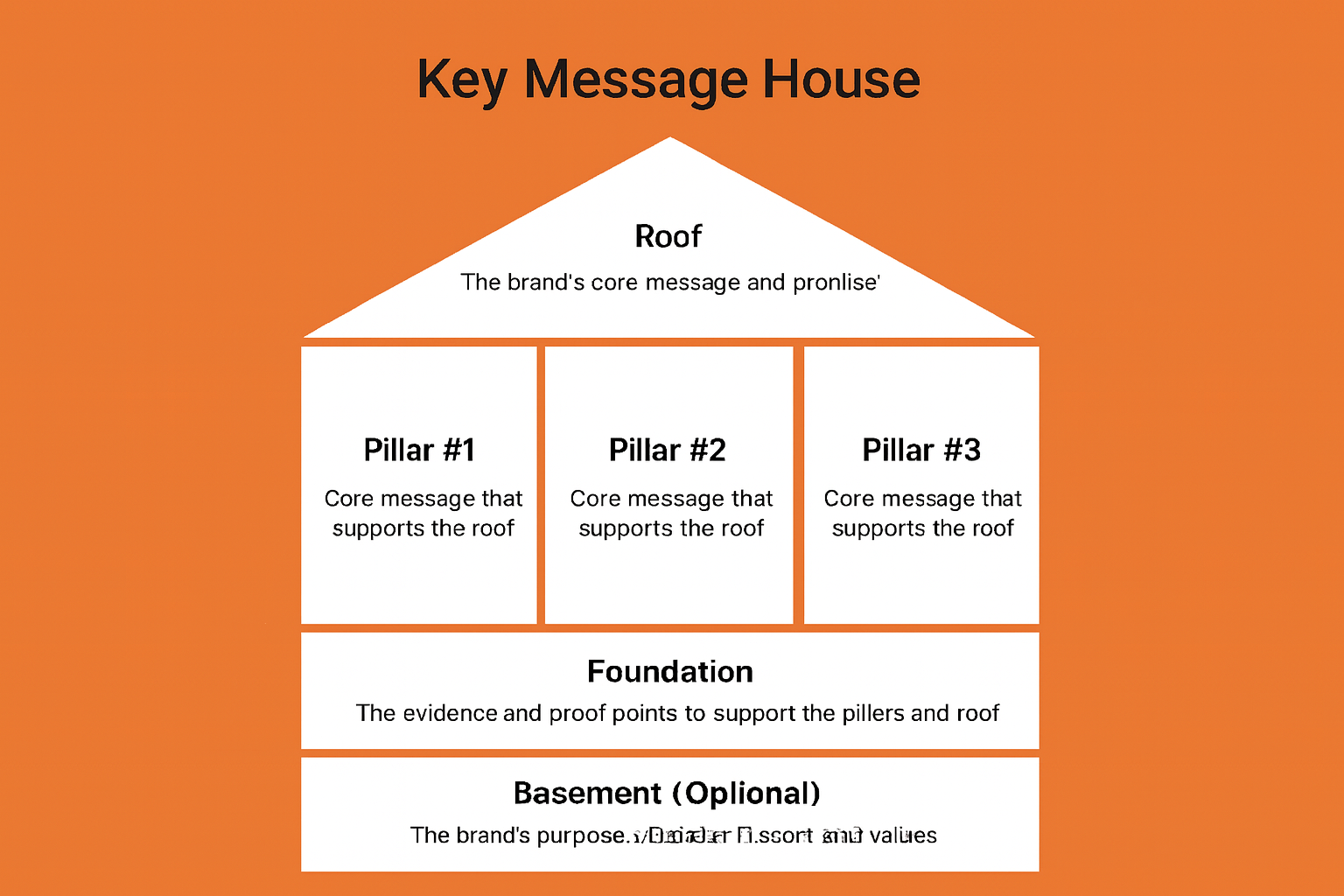
A message house typically follows a simple structure:
- Roof (Core Narrative)
The overarching brand promise or positioning statement. - Pillars (3 Key Messages)
Strategic themes supporting the main narrative — often tied to value, innovation, trust, or differentiation. - Proof Points (Supporting Evidence)
Data, case studies, product features, or credentials validating each pillar. - Audience Adaptations
Optional variations tailored for media, customers, investors, or partners.
Best Practices
– Keep language concise and conversational.
– Avoid jargon unless audience-specific.
– Use evidence, not slogans.
– Test messages against real communication scenarios.
– Update annually or during major strategic shifts.
How to Use a Message House Effectively
Once developed, a message house should become a living operational tool:
– Integrate into media training and spokesperson briefs.
– Use as the foundation for campaign planning.
– Include in agency and influencer onboarding.
– Align SEO and editorial calendars around message pillars.
– Reference during crisis-response drafting.
Organizations that operationalize their message houses — rather than treating them as static documents — gain the greatest strategic value.
The Foundeast Perspective
At Foundeast, message houses are not viewed as PR-only frameworks but as central architecture for integrated communications. In an era where audiences move fluidly between media, platforms, and formats, messaging discipline is no longer optional — it is a competitive advantage.
Brands that invest in structured messaging communicate faster, scale more effectively across markets, and build stronger long-term brand equity.