
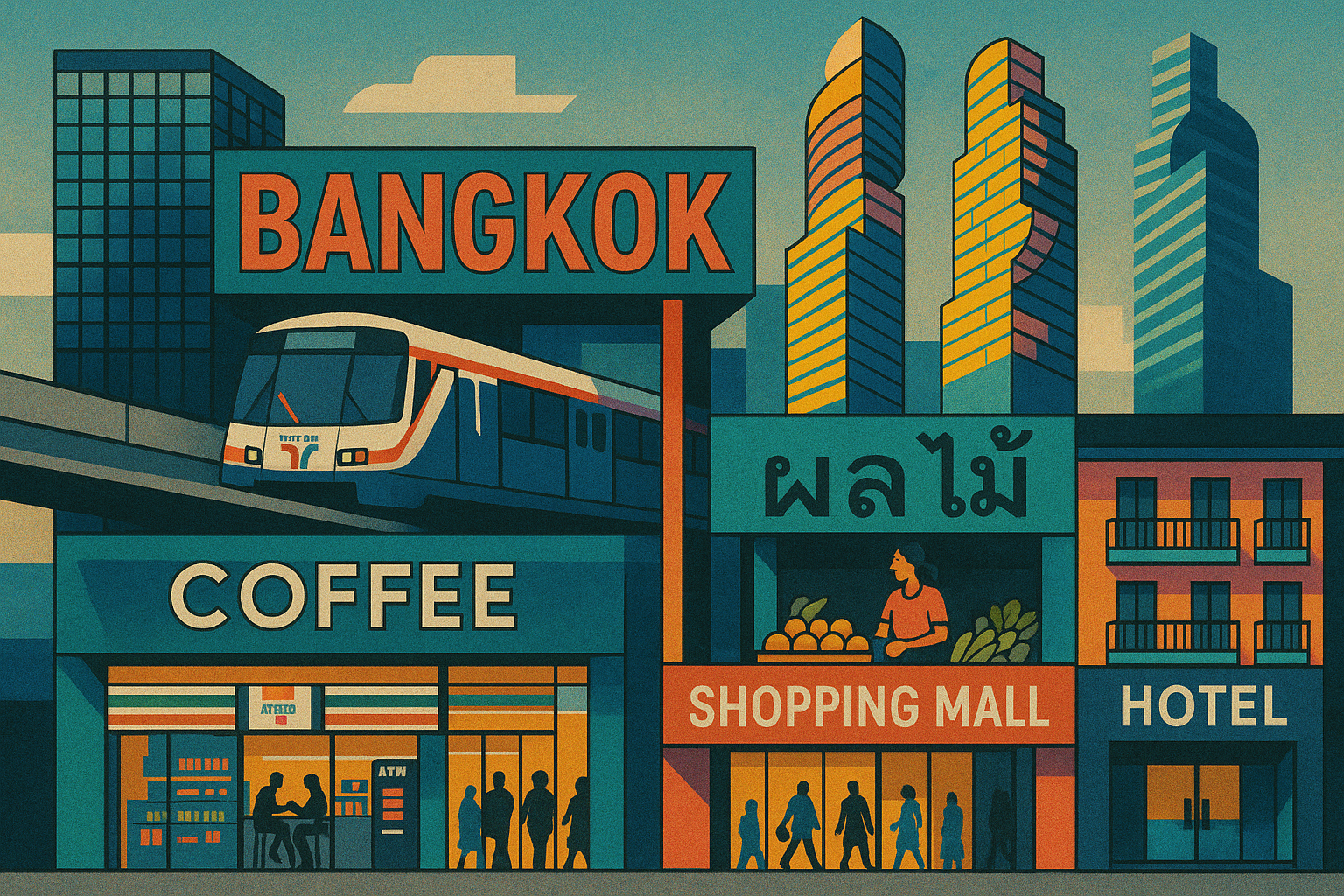
Search marketing and Artificial Intelligence are changing the way people in Bangkok discover local businesses. Google’s AI Overviews, ChatGPT-powered search, and other generative engines are starting to answer questions directly, leaving fewer clicks for traditional websites.
For restaurants, gyms, retailers, and service providers in Bangkok, this can feel like a threat. But it’s also an opportunity: businesses that learn how to optimize for AI-driven search will win visibility and trust long before their competitors.
Here’s how Bangkok businesses can adapt — step by step.
1. Shift From SEO to Answer Engine Optimization (AEO)
Traditional SEO focused on ranking for keywords like “best coffee shop in Bangkok.” But AI tools look for clear, structured answers they can summarize.
Action for Bangkok businesses:
- Build FAQ sections on your website in both English and Thai.
- Use FAQ schema markup so Google and ChatGPT can easily read your answers.
- Phrase content in conversational, question-based formats:
-
- “What is the best café near BTS Ari?”
- “How much does a coworking desk in Asoke cost per month?”
By answering these micro-questions, you give AI models the exact snippets they want to serve to users.
2. Go Hyperlocal Instead of City-Wide
Bangkok is huge, and “Bangkok” as a keyword is too broad. Customers – especially tourists and expats – search by landmarks, BTS/MRT stations, and sois.
Action for Bangkok businesses:
- Create landing pages or blog posts for specific neighborhoods and transport hubs.
- Example: instead of “Best gyms in Bangkok,” try:
- “Best gyms near Sathorn BTS”
- “Top yoga studios in Thonglor Soi 10”
- Add maps and walking directions from popular landmarks like Siam Paragon, Asoke Intersection, or CentralWorld.
This signals to AI search that your content matches intent + location, which is exactly what answer engines prioritize.
3. Make Reviews Work Harder for You
AI systems pull heavily from Google Maps, TripAdvisor, and Facebook reviews to decide which businesses to surface.
Action for Bangkok businesses:
- Encourage customers to leave reviews that mention location keywords (e.g., “Great Thai massage in Sukhumvit Soi 39”).
- Ask English-speaking customers to review in English so your business ranks across multilingual search queries.
- Reply to reviews promptly and naturally — AI models detect and reward active management.
4. Treat Social Media as Part of Your Search Marketing
In Bangkok, TikTok and Instagram are becoming discovery engines in their own right. Tourists search “Bangkok street food TikTok” or “best rooftop bars Bangkok Instagram” just as much as Google.
Action for Bangkok businesses:
- Post short-form videos geo-tagged to your exact location.
- Use both Thai and English captions with trending hashtags.
- Collaborate with local influencers who are already ranking in “near me” searches.
Remember: AI engines increasingly scrape social signals to decide which businesses are credible.
5. Build First-Party Data Channels
If AI search reduces website clicks, you need another way to connect with customers directly. In Bangkok, that means LINE, email, and loyalty programs.
Action for Bangkok businesses:
- Offer discounts or freebies in exchange for joining your LINE Official Account.
- Create exclusive geo-targeted LINE campaigns, such as “Happy Hour in Silom only.”
- Maintain newsletters with local content like “5 things to do in Sathorn this weekend.”
This protects your brand from depending only on search visibility.
6. Optimize Search Marketing for Voice Search & Thai Queries
More Bangkokians are using voice assistants in English and Thai. These queries are longer and more conversational than typed searches.
Action for Bangkok businesses:
- Write content that mirrors natural speech:
- Instead of “rooftop bar Bangkok,” try:
- “Where’s the best rooftop bar near Sukhumvit?”
- “Which rooftop bars in Silom are open past midnight?”
- Instead of “rooftop bar Bangkok,” try:
- Use Thai- and English-language phrases in content and reviews.
This helps capture both local and tourist audiences.
7. Strengthen Your Brand Authority in Bangkok
AI search doesn’t just look at keywords — it looks for trusted names. If your brand is mentioned across media, blogs, and events, you’re more likely to appear in AI answers.
Action for Bangkok businesses:
- Partner with local influencers, universities, or cultural events.
- Pitch your story to Thai media and lifestyle blogs.
- Sponsor or host community events in Thonglor, Ari, or Ekkamai to build mentions.
The more your brand appears in reputable sources, the more AI sees you as an authority.
Looking Ahead: Bangkok’s AI Search Marketing Future
By 2026, over 60% of local queries in Thailand are expected to be answered directly by AI. That means:
- Websites will be less important as entry points.
- Hyperlocal, conversational content will dominate.
- Social and Line campaigns will become equal pillars of visibility.
The businesses in Bangkok that adapt now — with AEO, hyperlocal targeting, review management, and brand authority — will be the ones customers see first when they ask AI where to go, eat, shop, or exercise.
Conclusion
AI-driven search is not the end of digital visibility for Bangkok businesses — it’s the next chapter. The winners will be those who:
- Answer customer questions clearly
- Target specific districts and landmarks
- Encourage rich, multilingual reviews
- Treat social media as part of SEO
- Invest in first-party LINE and email lists
By following these steps, local businesses can stay visible, competitive, and trusted — no matter how AI reshapes search in Bangkok. Bangkok is a city of constant reinvention. Its businesses must embrace the same mindset to thrive in an AI-first search era.